I got a little spun around by the fun of this blog thingy and got distracted by the excitement I feel when planning and designing. While it’s cool and fun for me to research, ultimately there are parts where it takes banal and unglamorous work. Gradual incremental effort – though punctuated by gushing moments of breakthrough – but generally grinding sleeves-rolled-up work. Sometimes it is effortlessly let-the-sparks-fly leaping forward and sometimes it just plain takes work.
I’m forcing myself to go into just such a work phase right now. I’ve got many weeks’ worth of speculations, so I’m overdue for a period of knuckling-down. Simple pragmatic milling out of flour from corn: clarifying the articles of incorporation; establishing most of the specifics of the operating agreement. Speculative posts will likely take a back seat to status and retrospect. This is just as well as the day job is heating back up a bit and I’m trying to attend to my goal of being more sociable.
Next step: a practical accomplishment and then a post.
* And without the kissing.
25 September 2007

20 September 2007
Scaling back
Based on my experience so far, posting thoughtfully takes two to five hours per day. Thus, doing that five times a week is a ten to twenty-five hour effort. That’s fine – enjoyable even – when I'm not, say, up to my neck in random work,* unexpected travel,˚˚ or any number of time-intensive domestic adventures.† Oh, and I also like having a social life and maybe be able to carve out some time to aller à bicyclette. Well, with enough distraction and time compression, I end up writing rushed. I’m not happy with the resulting rambling, lack of research, or degradation in the overall clarity of my communication.
Rather than scramble to keep up (or catch up), I think that the more sane tack is to blog less frequently. A few folks have told me that keeping up with five posts a week is a bit much anyhow. When people are commenting, it’s certainly a bit much for me. So I am scaling back to roughly three posts per week.
I'd be lying if I said I didn't feel a teensy bit like this:

But all things considered, The sheer volume of posting I was doing really was excessive unless blogging was going to become a cornerstone of the business. Which it almost certainly isn't.
To be clear, I am not quitting this project! I'm just blogging less. This will actually give me more time to do some of the administrative stuff to get this thing up and running within a reasonable timeframe.
Now I’m going to have a lovely cup of tea, ride the bike to Seattle and back, and then learn something called “Xcelsius.” I am assured that, despite the moniker, it is not a comic book villain. That is actually a little bit disappointing.
* The word design is in your title, so I’m sure you do graphic design also, right? No? Really? But… but “design.” Well, do it anyway.
˚˚ Hey there Tennessee, how’s the meat? Still in everything? Thought so. And yes, in case you haven’t been, in addition to being rich in antioxidants, vegetables are also rich in meat in the South.
† Fun with geometry! Pack a 400 ft² studio with 800 ft² of stuff. It can be done using only ordinary third order n-dimensional Euclidean space. Also? Check your messages. Sometimes your mother thinks you’re dead when you don’t return calls for a week. Surprise! Still alive!
Updated 20 September to correct word-choice typos and add the Natalie Dee image with accompanying paragraphs.
Rather than scramble to keep up (or catch up), I think that the more sane tack is to blog less frequently. A few folks have told me that keeping up with five posts a week is a bit much anyhow. When people are commenting, it’s certainly a bit much for me. So I am scaling back to roughly three posts per week.
I'd be lying if I said I didn't feel a teensy bit like this:

But all things considered, The sheer volume of posting I was doing really was excessive unless blogging was going to become a cornerstone of the business. Which it almost certainly isn't.
To be clear, I am not quitting this project! I'm just blogging less. This will actually give me more time to do some of the administrative stuff to get this thing up and running within a reasonable timeframe.
Now I’m going to have a lovely cup of tea, ride the bike to Seattle and back, and then learn something called “Xcelsius.” I am assured that, despite the moniker, it is not a comic book villain. That is actually a little bit disappointing.
* The word design is in your title, so I’m sure you do graphic design also, right? No? Really? But… but “design.” Well, do it anyway.
˚˚ Hey there Tennessee, how’s the meat? Still in everything? Thought so. And yes, in case you haven’t been, in addition to being rich in antioxidants, vegetables are also rich in meat in the South.
† Fun with geometry! Pack a 400 ft² studio with 800 ft² of stuff. It can be done using only ordinary third order n-dimensional Euclidean space. Also? Check your messages. Sometimes your mother thinks you’re dead when you don’t return calls for a week. Surprise! Still alive!
Updated 20 September to correct word-choice typos and add the Natalie Dee image with accompanying paragraphs.
16 September 2007
Money and risk and the value thereof
I have never wanted for money. This is not to say that I haven’t been poor. [Social activist friends: please note that I am fully aware that even as a very poor American I would live far beyond the standard of living of most of the rest of the world. It is not lost on me that I’ve never truly known poverty.] I have been very poor, my family having had to live with my maternal grandparents for a short time when I was very young, living for a year on strange negotiations and about two thousand dollars in my late teens, eking out a livable though low-key existence on eighteen thousand a year in arts management when I was wrapping up college. Until recently, money has always been a terminal limitation on whether I had control over my life. And my valuation of money has changed across that span.
Even when things have been tight, I made good budgets and reasonable plans. I was able to graduate from college without debt (and then art school with a minor and manageable short-term debt). I was able to afford several bargain trips to Europe. I kept my expectations low, my obligations negligible, and my expenses minimal. I learned to be DIY wherever possible and to like it. My simple living and good planning let me take a lot of risks that I otherwise would not have been able to make. Fools Play afforded me a free education in business. The dotcom crash gave me a lasting object lesson [initial Freudian typo: lesion] in investment. I learned to manage risk and calculate the return on my aggressive investment.
Unchecked risk makes my skin crawl. Educated risk though, has been pretty easy – not painless, but easy – for me with my few obligations, unburdened by debt. I have taken carefully considered risks that have been sometimes expensive in the short term but always high-yielding in the long run for me. Risks that have wildly expanded my experience, broadened my skill set in surprising directions, raised my expectations around what is possible, and doubled my income every three years on the average.
I assume that there is a boundary somewhere around improving experience and skills, though I’ve not found it (and I’m not particularly worried that I’m about to run up against that barrier anytime soon). I seem to find it plenty easy to ratchet up my expectations as I come near meeting them so that I’m always hungry and a little uncomfortable. But in any realistic terms, I’m going to hit a ceiling within two years inside of the tech sector that will slow my income doubling trend by a factor of three. The next doubling will be the last for a decade or more… as an employee, that is. As someone with ownership, the rules change. The risk factor goes up but the rewards can be scalar as well.
Money isn’t zero sum. In a world where ideas can translate into resources, there is always room to generate new money where there was none before. All the same, I am underwhelmingly happy on ethical grounds about presiding over a steadily growing nest egg. Without skin in the game, it is arguable that this is in practical terms all I am doing right now. There can be a fine line between saving and hoarding, and it’s well established* that hoarding has a poisonous effect on the world around the hoarder, both directly and indirectly. If I can generate strong revenue and therefore (presumably) much higher incomes, I can continue accelerating fiscal control over my life and help others to achieve the same sort of result. That definitely helps convince me that I’m no partner to hoarding and that this is the right direction to go.
* Look at me not citing this “well established” fact. Feel free to challenge me if my unsupported proclamation is insufficiently convincing and I’ll spend the time to go fetch the research.
Even when things have been tight, I made good budgets and reasonable plans. I was able to graduate from college without debt (and then art school with a minor and manageable short-term debt). I was able to afford several bargain trips to Europe. I kept my expectations low, my obligations negligible, and my expenses minimal. I learned to be DIY wherever possible and to like it. My simple living and good planning let me take a lot of risks that I otherwise would not have been able to make. Fools Play afforded me a free education in business. The dotcom crash gave me a lasting object lesson [initial Freudian typo: lesion] in investment. I learned to manage risk and calculate the return on my aggressive investment.
Unchecked risk makes my skin crawl. Educated risk though, has been pretty easy – not painless, but easy – for me with my few obligations, unburdened by debt. I have taken carefully considered risks that have been sometimes expensive in the short term but always high-yielding in the long run for me. Risks that have wildly expanded my experience, broadened my skill set in surprising directions, raised my expectations around what is possible, and doubled my income every three years on the average.
I assume that there is a boundary somewhere around improving experience and skills, though I’ve not found it (and I’m not particularly worried that I’m about to run up against that barrier anytime soon). I seem to find it plenty easy to ratchet up my expectations as I come near meeting them so that I’m always hungry and a little uncomfortable. But in any realistic terms, I’m going to hit a ceiling within two years inside of the tech sector that will slow my income doubling trend by a factor of three. The next doubling will be the last for a decade or more… as an employee, that is. As someone with ownership, the rules change. The risk factor goes up but the rewards can be scalar as well.
Money isn’t zero sum. In a world where ideas can translate into resources, there is always room to generate new money where there was none before. All the same, I am underwhelmingly happy on ethical grounds about presiding over a steadily growing nest egg. Without skin in the game, it is arguable that this is in practical terms all I am doing right now. There can be a fine line between saving and hoarding, and it’s well established* that hoarding has a poisonous effect on the world around the hoarder, both directly and indirectly. If I can generate strong revenue and therefore (presumably) much higher incomes, I can continue accelerating fiscal control over my life and help others to achieve the same sort of result. That definitely helps convince me that I’m no partner to hoarding and that this is the right direction to go.
* Look at me not citing this “well established” fact. Feel free to challenge me if my unsupported proclamation is insufficiently convincing and I’ll spend the time to go fetch the research.
13 September 2007
Bonus bad habit: overcommit
- Help out a friend in Tennessee? Sure, no sweat.
- Work off-hour from an improvised home and mobile office at the same time? Yeah, okay.
- Do lots of stuff in town and push most work into the evening? Doable, but starting to sound inadvisable.
- Keep blogging as usual, several hours a day? This is a bad idea.
- Fill evenings with restaurants and cooking? Okay, now I’m just being dumb.
- Sacrifice almost two days to travel and then play a loser’s game of mad catch-up on a Friday? Sounds great, and for good measure add a dose of “my mother thought I was dead because I wasn’t answering my phone” and now we’re talkin’!
- Plan to spend the weekend sick or maybe just exhausted? Yeah. Plan for that.
12 September 2007
Bad habit: sainthood
Advance apologies for any offense to my saint-revering Christian readers. In my [non]defense: I knew it was wrong.
Everywhere I’ve been in the tech sector, I’ve been told that the rock stars of the field are the ones who go so far beyond what’s expected that it looks like they are able to perform miracles. The bigger the pond I’m in, the bigger the expected miracle. So if you really want to be that star performer, rake in the Big Bonus and get promoted once every other year, skipping a pay grade every other promotion until you are right up there with the top brass of middle management, then you’d best get your miracle on.
Except it’s a terrible idea.
Venerable
The project careens and careers toward unmitigated disaster and miraculously your climax-of-Spice-World*-like intervention saves the day. Cue applause and cheers (if you’re lucky). But your first miracle may be a fluke. The venerable candidate of office sainthood shall be investigated thoroughly in the postmortem [jargon, deliciously appropriate jargon]. Further miracles pending review, your current efforts are venerated; thou art a good dude to have on the team.
Phew – Your first miracle might be a fluke! Hopefully you didn’t put yourself out to make the miracle happen, hopefully it is just a fluke.
Blessed
Your works continue to be reviewed and it is seen that they are mighty and that you are blesséd in the eyes of the office. Your services and participation will assuredly be in high demand. Now, we don’t want you bored or lacking in challenge and, as you are such a very high performer, we are certain that you don’t want that either. Well then, what could be less boring and more challenging than being asked to work another miracle? Here, take this miserable derelict charred hulk of a product and make it the next Furby or Tickle Me Elmo or Pokémon. As thy many blessings are shewn, so shall thy work pile be increased.
Gasp – The inverse of once bitten twice shy is going on now. Are you a lucky rabbit’s foot or maybe, just maybe, you can pull the whole rabbit out of your hat whenever you want. Maybe you can be depended on to work miracles. Let’s find out, shall we?
Sainted
Third time’s the charm. Working three miracles means you’ve just established miraculous job performance as a routine. A standard has been set. Hopefully just for you, but maybe for your whole team. I won’t be getting that sweet 20% bonus you’re getting for performing at 400%.˚˚ Shucks. Some people are just geniuses, I guess. Some people really know how to hit the home runs. I’ll just have to make do with my base hits. After all, I’ve got this family and these hobbies and those friends, and they all take up so much of my free time. But you? You’ve got my admiration and that sexy title on your business card and a bit more cash on hand.
Shudder – “Congratulations” on your beatification. Saints have a special relationship with god, and that’s got to be one of the most rewarding experiences possible. Oh, wait though. You’re not a saint, hangin’ with el hefe J and playing bocce with angels. You’re a smoke-jumping wildcard talent or a nose to the grindstone obsessive. Probably both.
Could we sharpen and hone that talent and get you onto a saner and predictable schedule? Because you’ve disrupted the way the company operates with your productive mania. Most companies will be all too happy to be disrupted in this way. But now the company needs you to churn out miracles. It needs it, but it probably doesn’t even know that it’s become dependent – it just takes your golden eggs for granted. Your workmates also come to depend on your Herculean efforts. And maybe they resent you for it too. But also, maybe no one at all really appreciates or understands your ability and potential. Maybe success is assumed and you’ll go the distance to get us all there instead of letting the reasonable failure come about from launching out on Mr. Toad’s Wild Ride. You make even the most harebrained schemes possible. When you’re gone (you’ve probably imploded), your reckless and imprudent bosses will expect your coworkers to pick up the slack. They might even think they can. Sometimes a bad project or idea or boss or team has got to hit bottom before a happy ending can come about.
You don’t actually need to be officially canonized – informal habitual sainthood is just as bad as the recognized variety. At least try not to get caught personally performing your miracles. Here's my last bit of well-meaning hyperbole, because I like you – we should hang out more. Soon. Because you don't have a lot of time left. Saints technically need to be dead. Don’t worry, you’ll be dead soon enough. Dead tired, dead to the world, looking like death warmed over. Until one of the big four stress-induced killers actually does shuffle you off.
* I'll tell you what, if it’s good enough for Stephen Fry and Elvis Costello, then it’s well good enough for me.
˚˚ You get paid $100,000 a year and perform at 400%. You get a 20% bonus of $20,000. My question, if I were you, would be “could I have the other three years’ worth of salary instead for performing adequately as four people? Because while I like $20,000 and the prestige of getting a juicy merit-based bonus, last I checked, $300,000 is (A) fifteen times as much as $20,000 and (B) a great heaping gob of money.”
Everywhere I’ve been in the tech sector, I’ve been told that the rock stars of the field are the ones who go so far beyond what’s expected that it looks like they are able to perform miracles. The bigger the pond I’m in, the bigger the expected miracle. So if you really want to be that star performer, rake in the Big Bonus and get promoted once every other year, skipping a pay grade every other promotion until you are right up there with the top brass of middle management, then you’d best get your miracle on.
Except it’s a terrible idea.
Venerable
The project careens and careers toward unmitigated disaster and miraculously your climax-of-Spice-World*-like intervention saves the day. Cue applause and cheers (if you’re lucky). But your first miracle may be a fluke. The venerable candidate of office sainthood shall be investigated thoroughly in the postmortem [jargon, deliciously appropriate jargon]. Further miracles pending review, your current efforts are venerated; thou art a good dude to have on the team.
Phew – Your first miracle might be a fluke! Hopefully you didn’t put yourself out to make the miracle happen, hopefully it is just a fluke.
Blessed
Your works continue to be reviewed and it is seen that they are mighty and that you are blesséd in the eyes of the office. Your services and participation will assuredly be in high demand. Now, we don’t want you bored or lacking in challenge and, as you are such a very high performer, we are certain that you don’t want that either. Well then, what could be less boring and more challenging than being asked to work another miracle? Here, take this miserable derelict charred hulk of a product and make it the next Furby or Tickle Me Elmo or Pokémon. As thy many blessings are shewn, so shall thy work pile be increased.
Gasp – The inverse of once bitten twice shy is going on now. Are you a lucky rabbit’s foot or maybe, just maybe, you can pull the whole rabbit out of your hat whenever you want. Maybe you can be depended on to work miracles. Let’s find out, shall we?
Sainted
Third time’s the charm. Working three miracles means you’ve just established miraculous job performance as a routine. A standard has been set. Hopefully just for you, but maybe for your whole team. I won’t be getting that sweet 20% bonus you’re getting for performing at 400%.˚˚ Shucks. Some people are just geniuses, I guess. Some people really know how to hit the home runs. I’ll just have to make do with my base hits. After all, I’ve got this family and these hobbies and those friends, and they all take up so much of my free time. But you? You’ve got my admiration and that sexy title on your business card and a bit more cash on hand.
Shudder – “Congratulations” on your beatification. Saints have a special relationship with god, and that’s got to be one of the most rewarding experiences possible. Oh, wait though. You’re not a saint, hangin’ with el hefe J and playing bocce with angels. You’re a smoke-jumping wildcard talent or a nose to the grindstone obsessive. Probably both.
Could we sharpen and hone that talent and get you onto a saner and predictable schedule? Because you’ve disrupted the way the company operates with your productive mania. Most companies will be all too happy to be disrupted in this way. But now the company needs you to churn out miracles. It needs it, but it probably doesn’t even know that it’s become dependent – it just takes your golden eggs for granted. Your workmates also come to depend on your Herculean efforts. And maybe they resent you for it too. But also, maybe no one at all really appreciates or understands your ability and potential. Maybe success is assumed and you’ll go the distance to get us all there instead of letting the reasonable failure come about from launching out on Mr. Toad’s Wild Ride. You make even the most harebrained schemes possible. When you’re gone (you’ve probably imploded), your reckless and imprudent bosses will expect your coworkers to pick up the slack. They might even think they can. Sometimes a bad project or idea or boss or team has got to hit bottom before a happy ending can come about.
You don’t actually need to be officially canonized – informal habitual sainthood is just as bad as the recognized variety. At least try not to get caught personally performing your miracles. Here's my last bit of well-meaning hyperbole, because I like you – we should hang out more. Soon. Because you don't have a lot of time left. Saints technically need to be dead. Don’t worry, you’ll be dead soon enough. Dead tired, dead to the world, looking like death warmed over. Until one of the big four stress-induced killers actually does shuffle you off.
* I'll tell you what, if it’s good enough for Stephen Fry and Elvis Costello, then it’s well good enough for me.
˚˚ You get paid $100,000 a year and perform at 400%. You get a 20% bonus of $20,000. My question, if I were you, would be “could I have the other three years’ worth of salary instead for performing adequately as four people? Because while I like $20,000 and the prestige of getting a juicy merit-based bonus, last I checked, $300,000 is (A) fifteen times as much as $20,000 and (B) a great heaping gob of money.”
11 September 2007
How would you like your bonus paid?
I should say bonuses, since that’s what I’m about to argue for. An annual bonus encourages you to keep your mouth closed about your issues with the team and with the company until you get your bonus and then walk, suddenly (and looking like a mercenary), having now stewed in your smoldering dissatisfaction for four or six months.
When I get my receipt from the grocery store, it usually indicates on it how much I saved [okay okay, or “saved”]. It’s like every time I buy groceries I get a little bonus. Admittedly, it’s a bit of marketing flimflam. But it’s still a nice little hook, this reward for my fish- and bread- and wine-acquiring accomplishments. The part I like about the flimflam – the part that’s not flimflam at all – is that the grocery store genuinely does appreciate my contribution. If possible, they’d like me to know that I’m appreciated each and every time I deal with them.
I can’t say I’m not motivated by getting a bonus.* The two bonuses I like the best?
It’s not so hard to ask you how you’d like to be bonused and then reward you in accordance with your express preferences. Mightn’t you be inclined to be more loyal then? More productive? More forward with your issues? More patient with management’s foibles?
You might, rabbit. You might.
* Though I am a few standard deviations off the norm since I calculate investment:reward ahead of time wherever possible when it comes to bonusing. I’d like to determine the real value of those bonus dollars in exchange for the time, effort, and possible crazymaking incumbent upon earning them. Sometimes the money just ain’t worth it. Sometimes those extra hours are getting paid out at less than half of what I’m normally getting paid. Sometimes those extra hours are getting paid out at less than minimum wage. And gosh, I surely would love to work for less than minimum wage! Thoinx! And could you also punch me in the groin? I love that too!
¹ If I’m not in a position to give you a monetary reward, I am going to write you up and send that recommendation off to you and your boss.
² So, I’ve actually been criticized for recognizing success. I pointed out the people who worked on the project and mentioned them as necessary to the success of the project. That’s it. Apparently, that’s a “love fest” worthy of public scorn. Ouch. No wonder I don’t work for that company anymore. On the same project, I was told that success is assumed so only home runs were worthy of recognition – this from a group that consistently failed across a big board o’ projects on the books.
³ Which is a better executive? The one prepared to take a big risk and goes for it, shooting from the hip? Or the one prepared to take a big risk and goes for it, having planned to adjust for the danger ahead?
When I get my receipt from the grocery store, it usually indicates on it how much I saved [okay okay, or “saved”]. It’s like every time I buy groceries I get a little bonus. Admittedly, it’s a bit of marketing flimflam. But it’s still a nice little hook, this reward for my fish- and bread- and wine-acquiring accomplishments. The part I like about the flimflam – the part that’s not flimflam at all – is that the grocery store genuinely does appreciate my contribution. If possible, they’d like me to know that I’m appreciated each and every time I deal with them.
I can’t say I’m not motivated by getting a bonus.* The two bonuses I like the best?
- Spot bonus. That thing I just did that was particularly beneficial got noticed and now suddenly I’ve got a trivial gift in hand. That trivial gift is directly related to something I like: dinner at the Stumbling Goat; credit at the Triple Door; an Amazon gift certificate (well, hard to go wrong there with anybody…). A spot bonus, even a little one, says that my good work is recognized and has instant gratification attached as well.¹
- Launch bonus. The project I just finished was a success. A small bonus goes a long way when acknowledging success. And success should always be celebrated. Sure, I am expected to succeed. But when I do, I should still be praised. Respectable success? A bottle of the Albariño I like. Admirable success? A bottle of 16 year Lagavulin. Marvelous success? A century-old Delamain cognac.²
It’s not so hard to ask you how you’d like to be bonused and then reward you in accordance with your express preferences. Mightn’t you be inclined to be more loyal then? More productive? More forward with your issues? More patient with management’s foibles?
You might, rabbit. You might.
* Though I am a few standard deviations off the norm since I calculate investment:reward ahead of time wherever possible when it comes to bonusing. I’d like to determine the real value of those bonus dollars in exchange for the time, effort, and possible crazymaking incumbent upon earning them. Sometimes the money just ain’t worth it. Sometimes those extra hours are getting paid out at less than half of what I’m normally getting paid. Sometimes those extra hours are getting paid out at less than minimum wage. And gosh, I surely would love to work for less than minimum wage! Thoinx! And could you also punch me in the groin? I love that too!
¹ If I’m not in a position to give you a monetary reward, I am going to write you up and send that recommendation off to you and your boss.
² So, I’ve actually been criticized for recognizing success. I pointed out the people who worked on the project and mentioned them as necessary to the success of the project. That’s it. Apparently, that’s a “love fest” worthy of public scorn. Ouch. No wonder I don’t work for that company anymore. On the same project, I was told that success is assumed so only home runs were worthy of recognition – this from a group that consistently failed across a big board o’ projects on the books.
³ Which is a better executive? The one prepared to take a big risk and goes for it, shooting from the hip? Or the one prepared to take a big risk and goes for it, having planned to adjust for the danger ahead?
10 September 2007
I am (not) my job
Is it reassuring or discomfiting if an executive's identity is obviously, intrinsically, and inseparably tied to their position? No one is going to be bowled over by my saying that your own identity shouldn't be wrapped up in your job. But what about the top tier bosses?
I know what I believe. I'll post it in the comments section, probably Friday morning.
I know what I believe. I'll post it in the comments section, probably Friday morning.
09 September 2007
JTTMJ
Just Trust The Monkey's Judgment*
A great friend of mine has been working on a series of film projects. One of the very old drafts dwells on a post-apocalyptic society ruled by an oracle-king with a staff of acolyte government ministers. These people interpret the king's communications and enforce the resulting rule of law. Ordinary citizens, for a number of contextually reasonable motives, enthusiastically follow the lead of this unseen and inaccessible divine font. You will not be shocked to find that the rules create a compelling and barely functional dystopia. Oh, and the king happens to be a captive monkey.
Fascinating, Edward. So… what are you talking about?
Well, now that I've written a short explication of how I think a company should aspire to act, I don't expect that to be the end of it – even if everyone says that yes, those comprise a great bunch of principles. It would not surprise me to find that doing only that invites the creation of a JTTMJ-like scenario. The acolytes abstract meaning from a monkey’s gestures; a standalone document is open to abject interpretation.
I should perhaps draw a conclusion here. Alas, all I’ve got at the moment is a cautionary sense that if the standards to which a company holds itself are not aggressively and wisely supported, it’s an invitation to disaster. So then, how about a tangent instead?
It has been pointed out to me that the set of people who can both agree to the spirit of my list of corporate principles and put those principles into practice is a narrow set indeed. At the same time, I don’t think that any of those people would be inclined to just trust the monkey’s judgment, so to speak. They're already going to be resistant to building up byzantine bureaucracy or cruelly adhering to the letter of dogma. If it’s just a few people, then that's the way it'll have to be. Actually, I think that could be a good thing. It is, maybe, a challenge to growth and scalability. But folks of that stripe should be drawn to a cluster of their peers. Exclusivity can be a strength, and a crowd draws a crowd, even a small crowd. It strikes me that a few committed people are better off by far than a large group of uncommitted people.
 * I’m using JTTMJ in a similar sense as drink the Kool-Aid. I think The Big Man would approve, though.
[Please note that this post will be radically altered if the originator of "JTTMJ" objects to its use here.]
A great friend of mine has been working on a series of film projects. One of the very old drafts dwells on a post-apocalyptic society ruled by an oracle-king with a staff of acolyte government ministers. These people interpret the king's communications and enforce the resulting rule of law. Ordinary citizens, for a number of contextually reasonable motives, enthusiastically follow the lead of this unseen and inaccessible divine font. You will not be shocked to find that the rules create a compelling and barely functional dystopia. Oh, and the king happens to be a captive monkey.
Fascinating, Edward. So… what are you talking about?
Well, now that I've written a short explication of how I think a company should aspire to act, I don't expect that to be the end of it – even if everyone says that yes, those comprise a great bunch of principles. It would not surprise me to find that doing only that invites the creation of a JTTMJ-like scenario. The acolytes abstract meaning from a monkey’s gestures; a standalone document is open to abject interpretation.
I should perhaps draw a conclusion here. Alas, all I’ve got at the moment is a cautionary sense that if the standards to which a company holds itself are not aggressively and wisely supported, it’s an invitation to disaster. So then, how about a tangent instead?
It has been pointed out to me that the set of people who can both agree to the spirit of my list of corporate principles and put those principles into practice is a narrow set indeed. At the same time, I don’t think that any of those people would be inclined to just trust the monkey’s judgment, so to speak. They're already going to be resistant to building up byzantine bureaucracy or cruelly adhering to the letter of dogma. If it’s just a few people, then that's the way it'll have to be. Actually, I think that could be a good thing. It is, maybe, a challenge to growth and scalability. But folks of that stripe should be drawn to a cluster of their peers. Exclusivity can be a strength, and a crowd draws a crowd, even a small crowd. It strikes me that a few committed people are better off by far than a large group of uncommitted people.
* I’m using JTTMJ in a similar sense as drink the Kool-Aid. I think The Big Man would approve, though.[Please note that this post will be radically altered if the originator of "JTTMJ" objects to its use here.]
06 September 2007
Call to comment
“One is happy as a result of one’s own efforts, once one knows of the necessary ingredients of happiness - simple tastes, a certain degree of courage, self-denial to a point, love of work, and, above all, a clear conscience. Happiness is no vague dream, of that I now feel certain.”
I've been sitting on that George Sand quote for a while, and it seems apropos today. Tremendously despairing dreams last night, essentially just thinky disaster movies. Unremarkably, much of the same terrain I've been travelling in the past three posts was covered albeit from an inverted view. So now that I've obviously been thinking too much about corporate virtue, I'm going to back away from it over the weekend.
Since you're not actually dreaming about it, perhaps you can think about it on my behalf. This is an area in which I do not want to act in a vacuum. I've had a few good discussions with folks in this vein - that list didn't just appear like Athena - but not enough for me to feel comfortable with moving forward yet. So this is a call to comment. Anyone care to chime in on the four corporate principles posts? See something I've left out? Duplicated? Think that a principle I included is not that important? Is not well described? Is just hype? Like the flower presentation? Hate it? Confused by anything? I'm not asking for necessarily fully formed thoughts. Even shoot-from-the-hip reactions or impressions will be of great value.
—George Sand
I've been sitting on that George Sand quote for a while, and it seems apropos today. Tremendously despairing dreams last night, essentially just thinky disaster movies. Unremarkably, much of the same terrain I've been travelling in the past three posts was covered albeit from an inverted view. So now that I've obviously been thinking too much about corporate virtue, I'm going to back away from it over the weekend.
Since you're not actually dreaming about it, perhaps you can think about it on my behalf. This is an area in which I do not want to act in a vacuum. I've had a few good discussions with folks in this vein - that list didn't just appear like Athena - but not enough for me to feel comfortable with moving forward yet. So this is a call to comment. Anyone care to chime in on the four corporate principles posts? See something I've left out? Duplicated? Think that a principle I included is not that important? Is not well described? Is just hype? Like the flower presentation? Hate it? Confused by anything? I'm not asking for necessarily fully formed thoughts. Even shoot-from-the-hip reactions or impressions will be of great value.
05 September 2007
Good habit: punctuality
It's so kids' stuff to harp on punctuality, but here I go anyhow.
Lateness costs money
Imagine a meeting with ten people. The meeting cannot begin until everyone is there. These people cost the company about a hundred dollars an hour to employ. The meeting starts fifteen minutes late. The price tag on that one time delay is $250. If that's a weekly event, it's about $12,500/year. Once daily? $62,500/year. I had that meeting at least three times a day every day while at Microsoft. Microsoft spent $200,000 for my team to wait over the course of a year. Just my team alone.
Lateness costs productivity
The same scenario as before yields the following lost work hours: 2.5 hours vanish for a one-time event. A little over three work weeks vanish over a year for a once weekly delay. That delay daily vanishes about a month (distributed across the team) during a year. My team lost about a full quarter of productivity in a year. By waiting. I should mention that my team was directly responsible for helping (or hindering) all other groups release their software out to the market.
Lateness costs good will
It may just be adding insult to injury, but this insult can lose sales, impair relationships, and sometimes even scuttle whole businesses. The signal that you send by making me wait - knowing that it costs my company and knowing that it hampers my productivity - is that your time is above those concerns and above my own concerns as well. At best, being late can be forgivably rude. Being on time is easy, so it had better be worth it to wait.
Lateness costs money
Imagine a meeting with ten people. The meeting cannot begin until everyone is there. These people cost the company about a hundred dollars an hour to employ. The meeting starts fifteen minutes late. The price tag on that one time delay is $250. If that's a weekly event, it's about $12,500/year. Once daily? $62,500/year. I had that meeting at least three times a day every day while at Microsoft. Microsoft spent $200,000 for my team to wait over the course of a year. Just my team alone.
Lateness costs productivity
The same scenario as before yields the following lost work hours: 2.5 hours vanish for a one-time event. A little over three work weeks vanish over a year for a once weekly delay. That delay daily vanishes about a month (distributed across the team) during a year. My team lost about a full quarter of productivity in a year. By waiting. I should mention that my team was directly responsible for helping (or hindering) all other groups release their software out to the market.
Lateness costs good will
It may just be adding insult to injury, but this insult can lose sales, impair relationships, and sometimes even scuttle whole businesses. The signal that you send by making me wait - knowing that it costs my company and knowing that it hampers my productivity - is that your time is above those concerns and above my own concerns as well. At best, being late can be forgivably rude. Being on time is easy, so it had better be worth it to wait.
04 September 2007
Three posts about fifteen things [ iii ]
I feel like this last set of traits are practically gimme’s. Not to say that they aren’t worth mentioning, but that I felt like I needed to have a good justification for the other two sets, especially the Greek¹. But they’re not gimme’s: it is not often that I see these qualities demonstrated at work. I think that’s because acting (especially acting publicly) on these qualities can make an employee particularly vulnerable to predation. So if I intend to keep these on the board, I’d better make it easy and safe for people to be decent to one another and unpleasant for them to not.
Passion (Integrity ∩ Arete ∩ Eudaimonia « Sustainability)
This is why I don’t need to care whether you are having fun at work. If you enjoy what you are doing, find it satisfying and fulfilling, can muster genuine enthusiasm, then fun is an incidental bonus. Part of what makes this principle cool to me is that in order to adhere to it, an employee and a company have to reach a consensus about role and action. As usual, anything like this requires a high degree of trust and skilled managers of people. Frankly, I find that more often than not, passion is what leads good people away from a company – not deeper into it. That’s broken, mostly on the management side of the equation.
Optimism² (Arete ∩ Sustainability » Eudaimonia ∩ Family)
If Pierre Reverdy can assert that love doesn’t exist – only proofs of love³ – then I’m comfortable making the less contentious observation that optimism without evidence is no different than delusion. I must admit that optimism has gotten me in trouble: A company not worthy of your optimism is sure to be a source of your dismay. It’s worth the risk for me anyhow. When my optimism wanes, it’s a strong indicator that I am not long from the door. Like passion, optimism begs a constant negotiation between company and employee with management as the facilitator. Obviously it also helps to have peers that are optimistic. Optimism isn’t hopefulness. Hope is passive. Optimism needs to be active, agreed upon in context and willed into being.
Stewardship (Sustainability » Eudaimonia ∩ Family ∩ Phronesis « Wisdom)
You can have a pet if you can take care of it. You can have a project for the same reason. I expect you to be able to think through to the logical conclusion of taking care of a project. [What happens to the waste exhaust from a car? The waste heat? The scrap materials when the consumer is done with it? Someone wasn’t grown up enough to have had a project, I’d say.] The logical starting point as well! [An ounce of design is worth a pound of revision. Interesting discussion at One Man Hacking.] This extends to relationships as well as projects.
Agility (Family ∩ Wisdom » Phronesis ∩ Integrity)
One can’t just act or respond quickly. That’s going to be chaos. So agility has to be tempered by pragmatic forethought and lucid consideration of what the right thing to do may be. And then also act or respond quickly.
Transparency (Wisdom » Phronesis ∩ Integrity ∩ Arete)
Again, Wikipedia comes in so handy in not having to reinvent the wheel. “Transparency implies openness, communication, and accountability. It is a metaphorical extension of the meaning used in the physical sciences: a ‘transparent’ object is one that can be seen through… Transparency cannot exist as a purely one-way communication though… [it] creates an everyday participation.” Structurally, corporate transparency has a peripheral benefit springing from the participatory opportunities – employees are always at least passively involved in the business. It’s a step closer to partnership than most senior management folks seem to be comfortable with. In my view, if I can’t trust the people in my company with even passive involvement, then I don’t want the people. Or maybe the company.
¹ I’m still torn about using the actual Greek words. Plenty of time to think it through yet.
² I’m sticking with optimism over sustainability. The conventional notion of sustainability should be sufficiently covered by stewardship.
³ "Il n'y a pas d'amour, il n'y a que des preuves d'amour."
Passion (Integrity ∩ Arete ∩ Eudaimonia « Sustainability)
This is why I don’t need to care whether you are having fun at work. If you enjoy what you are doing, find it satisfying and fulfilling, can muster genuine enthusiasm, then fun is an incidental bonus. Part of what makes this principle cool to me is that in order to adhere to it, an employee and a company have to reach a consensus about role and action. As usual, anything like this requires a high degree of trust and skilled managers of people. Frankly, I find that more often than not, passion is what leads good people away from a company – not deeper into it. That’s broken, mostly on the management side of the equation.
Optimism² (Arete ∩ Sustainability » Eudaimonia ∩ Family)
If Pierre Reverdy can assert that love doesn’t exist – only proofs of love³ – then I’m comfortable making the less contentious observation that optimism without evidence is no different than delusion. I must admit that optimism has gotten me in trouble: A company not worthy of your optimism is sure to be a source of your dismay. It’s worth the risk for me anyhow. When my optimism wanes, it’s a strong indicator that I am not long from the door. Like passion, optimism begs a constant negotiation between company and employee with management as the facilitator. Obviously it also helps to have peers that are optimistic. Optimism isn’t hopefulness. Hope is passive. Optimism needs to be active, agreed upon in context and willed into being.
Stewardship (Sustainability » Eudaimonia ∩ Family ∩ Phronesis « Wisdom)
You can have a pet if you can take care of it. You can have a project for the same reason. I expect you to be able to think through to the logical conclusion of taking care of a project. [What happens to the waste exhaust from a car? The waste heat? The scrap materials when the consumer is done with it? Someone wasn’t grown up enough to have had a project, I’d say.] The logical starting point as well! [An ounce of design is worth a pound of revision. Interesting discussion at One Man Hacking.] This extends to relationships as well as projects.
Agility (Family ∩ Wisdom » Phronesis ∩ Integrity)
One can’t just act or respond quickly. That’s going to be chaos. So agility has to be tempered by pragmatic forethought and lucid consideration of what the right thing to do may be. And then also act or respond quickly.
Transparency (Wisdom » Phronesis ∩ Integrity ∩ Arete)
Again, Wikipedia comes in so handy in not having to reinvent the wheel. “Transparency implies openness, communication, and accountability. It is a metaphorical extension of the meaning used in the physical sciences: a ‘transparent’ object is one that can be seen through… Transparency cannot exist as a purely one-way communication though… [it] creates an everyday participation.” Structurally, corporate transparency has a peripheral benefit springing from the participatory opportunities – employees are always at least passively involved in the business. It’s a step closer to partnership than most senior management folks seem to be comfortable with. In my view, if I can’t trust the people in my company with even passive involvement, then I don’t want the people. Or maybe the company.
¹ I’m still torn about using the actual Greek words. Plenty of time to think it through yet.
² I’m sticking with optimism over sustainability. The conventional notion of sustainability should be sufficiently covered by stewardship.
³ "Il n'y a pas d'amour, il n'y a que des preuves d'amour."
03 September 2007
Three posts about fifteen things [ ii ]
I shall now tread into dangerous jargon infested waters. Vision and Diversity are such loaded words - loaded with baggage that drains them of meaning when employed in the office. So I'm not at all opposed to trading up to something less ruined. Fit Judgment, while not jargon, is awkward twice over: it stumbles off one's tongue like the phrase "it stumbles off one's tongue" and it contains the word judgment which scares people. I would be excited about someone capturing a better term for this principle.
Accomplishment¹ (Integrity ∩ Arete)
Git 'er done is insufficient. Accomplishment includes ethical behavior, looking out for everyone's best interests, follow-through, etc.; I think it's fairly clear where this is going. This is the quality of being able to generate a set of desired results whilst exercising the personal valor to do it rightly.
Vision (Arete ∩ Eudaimonia « Sustainability)
To have vision is to posses (a) the knowledge required fulfill a worthy purpose or function, and (b) the ability to articulate how to apply that knowledge in order to fulfill it. So it’s both being able to conceptualize the problem (and the domain in which the problem lies) as well as being able to describe how to approach a reasonable resolution.
Diversity (Sustainability » Eudaimonia ∩ Family)
Giving lip service alone to diversity is dumb. A group that doesn't respect and respond to diversity actively ignores opportunities aplenty. People think wildly differently, bring many perspectives and skills to bear, have unexpected and occasionally thunderously useful experiences that don't immediately appear to have a practical application but may very well end up being the keys to unlock particularly unruly problems. Failure to seek out diversity promotes the aggregation of like minds with like failings and universal blind spots. Dumb. I don't have the data on me, but I recall having come across research on diversity being a little more expensive [Observe either all or no religious holidays, not just the Christian ones.] and stressful [Different people? But I fear and resist what is different!] in the short term but considerably more cost-effective over the long term and especially valuable in creating advanced communication mechanisms (e.g. cross-cultural fluency), problem solving efficiencies (e.g. greater variety in brainstorming ideas and how to make them workable), and casual mentoring practices (e.g. even casual mavens want to give away help).
Creativity (Family ∩ Phronesis « Wisdom)
You should be able (and encouraged) to explore a body of ideas and possibilities, from the obvious to the arcane. From there, you can iterate through the applications of your ideas, look down the pathways they open, and recognize and explore the unconventional tools at your disposal. I hope to imply within the broad notion of creativity additional specific notions of inspiration, flexible thinking, versatility, and so forth.
Fit Judgment² (Wisdom » Phronesis ∩ Integrity)
Make well-considered and defensible decisions. The marriage of knowing (or figuring out) the right thing to do and being strong enough to do it (or make a plan around how to do it) strikes me as a bit of critical thinking and basic sensibility that, if lacking, is going to impede your progress and that of everyone around you. Nonetheless, I have never seen this or anything like it as a publicly acknowledged corporate practice (Part of that might come from HR [or the "People Department" in some places; trust us, you're not an interchangeable human resource - that would be dehumanizing and set you up for comparable valuation to a self-administrating machine] since independent judgment is a FLSA exemption criterion.).
Updated 04 September to correct punctuation, improve phrasing, and clarify declarations under Vision, Diversity, and Fit Judgment.
¹ Wiktionary has a sweet secondary definition of accomplishment: "That which completes, perfects, or equips thoroughly; acquirement; attainment; that which constitutes excellence of mind, or elegance of manners, acquired by education or training." Nice!
² A momentary side note on judgment as a charged term. People judge all the time. It’s a basic survival instinct and it’s a bedrock component of good decision making. And it’s fundamentally neutral. The application of judgment, once it leaves your brain and is turned into real-world action, is not neutral. The application of judgment is charged with good, bad, or otherwise. We shouldn’t be reluctant to judge but we should be reluctant to judge and then act rashly.
Accomplishment¹ (Integrity ∩ Arete)
Git 'er done is insufficient. Accomplishment includes ethical behavior, looking out for everyone's best interests, follow-through, etc.; I think it's fairly clear where this is going. This is the quality of being able to generate a set of desired results whilst exercising the personal valor to do it rightly.
Vision (Arete ∩ Eudaimonia « Sustainability)
To have vision is to posses (a) the knowledge required fulfill a worthy purpose or function, and (b) the ability to articulate how to apply that knowledge in order to fulfill it. So it’s both being able to conceptualize the problem (and the domain in which the problem lies) as well as being able to describe how to approach a reasonable resolution.
Diversity (Sustainability » Eudaimonia ∩ Family)
Giving lip service alone to diversity is dumb. A group that doesn't respect and respond to diversity actively ignores opportunities aplenty. People think wildly differently, bring many perspectives and skills to bear, have unexpected and occasionally thunderously useful experiences that don't immediately appear to have a practical application but may very well end up being the keys to unlock particularly unruly problems. Failure to seek out diversity promotes the aggregation of like minds with like failings and universal blind spots. Dumb. I don't have the data on me, but I recall having come across research on diversity being a little more expensive [Observe either all or no religious holidays, not just the Christian ones.] and stressful [Different people? But I fear and resist what is different!] in the short term but considerably more cost-effective over the long term and especially valuable in creating advanced communication mechanisms (e.g. cross-cultural fluency), problem solving efficiencies (e.g. greater variety in brainstorming ideas and how to make them workable), and casual mentoring practices (e.g. even casual mavens want to give away help).
Creativity (Family ∩ Phronesis « Wisdom)
You should be able (and encouraged) to explore a body of ideas and possibilities, from the obvious to the arcane. From there, you can iterate through the applications of your ideas, look down the pathways they open, and recognize and explore the unconventional tools at your disposal. I hope to imply within the broad notion of creativity additional specific notions of inspiration, flexible thinking, versatility, and so forth.
Fit Judgment² (Wisdom » Phronesis ∩ Integrity)
Make well-considered and defensible decisions. The marriage of knowing (or figuring out) the right thing to do and being strong enough to do it (or make a plan around how to do it) strikes me as a bit of critical thinking and basic sensibility that, if lacking, is going to impede your progress and that of everyone around you. Nonetheless, I have never seen this or anything like it as a publicly acknowledged corporate practice (Part of that might come from HR [or the "People Department" in some places; trust us, you're not an interchangeable human resource - that would be dehumanizing and set you up for comparable valuation to a self-administrating machine] since independent judgment is a FLSA exemption criterion.).
Updated 04 September to correct punctuation, improve phrasing, and clarify declarations under Vision, Diversity, and Fit Judgment.
¹ Wiktionary has a sweet secondary definition of accomplishment: "That which completes, perfects, or equips thoroughly; acquirement; attainment; that which constitutes excellence of mind, or elegance of manners, acquired by education or training." Nice!
² A momentary side note on judgment as a charged term. People judge all the time. It’s a basic survival instinct and it’s a bedrock component of good decision making. And it’s fundamentally neutral. The application of judgment, once it leaves your brain and is turned into real-world action, is not neutral. The application of judgment is charged with good, bad, or otherwise. We shouldn’t be reluctant to judge but we should be reluctant to judge and then act rashly.
02 September 2007
Three posts about fifteen things [ i ]
 Three weeks, three days, or nothing? Three weeks would be fifteen daily postscripts. Three days would be three dedicated articles, three sets of five principles each. Nothing would be, well, nothin’ at all. Out: three weeks and nothing. Three weeks means I don’t get to talk about anything else until the end of September. I’m not writing a book on corporate standards of conduct, so that’s too much anyhow. Nothing just was never going to happen. So here goes: three posts about fifteen things, part one.
Integrity
People conducting business on the up-and-up should adhere to a common and discernible code of right and wrong.¹ It’s not a coincidence that I placed integrity on the top. Integrity is at the crown as the controlling virtue. For a framework that supports a group of people, I have a hard time conceiving that there is a more necessary underpinning. Go right ahead and argue with me: it may just be that I, personally, have no interest in you if you lack integrity and I’m allowing that very strong bias to bleed into my business theory.
By invoking integrity, I do not mean to imply subscription to any crypto-religious moral code. Admittedly, it’s a sticky wicket splitting hairs between morals and ethics. You can’t test for integrity. Literally, actually: in several states it’s against the law. It’s tantamount to a religious test which is outright banned… kinda.
Arete
Not the mountain ridge landform. I don’t think I can put it better than Wikipedia: “In its earliest appearance in Greek this notion of excellence was bound up with the notion of the fulfillment of purpose or function; the act of living up to one's full potential.” Arete is part and partner with strength of character and personal drive. It’s one of the arm positions because it’s inseparably tied in with action.
Sustainability » Eudaimonia
Sustainability was in the base position for obvious symbolic reasons. But I’m still infatuated with eudaimonia. And since I can swap out optimism with sustainability, I might just be able to have my cake and eat it too.
At the base of the flower image, I want two strong and nurturing pillars to support the active wings and to make the crown an easier weight. Eudaimonia, the quality of knowing what is needed to achieve and maintain a state of positive resolution, speaks strongly to purpose. We trade our skills and passions and time for reward and meaningful work and personal growth. Much of work can become a necessary evil, taking us away from the good things we value in our lives. We are all too often jilted of valuable reward, thwarted by make-work tasks, diverted from progressive development. Work should not only respect what is good in our lives but should be indivisibly part of that good itself.
Family
The office demands that you be a part of the team, investing a chunk of your identity the idea of the company, interacting directly and indirectly with a gang of sometimes seriously weird and inscrutable strangers, and spending a third of your waking life immersed in the corporate culture [jargon]. “Team” my ass - that’s an extended family. A company should have the guts to cop to the implicit demand to belong to its fam. [You could even argue that there's an implicit social contract there. And by you, I mean I. And by implicit I mean definite.]
Not only am I copping to it, I’m asserting that it can be a positive and supportive thing. So the company - and everyone in it - is going to be a part of your extended family. In your patchwork family of corporate orphans, you get to be exposed to many traditions and backgrounds. These people want to succeed and want you to succeed as well, if for no other reason than we will all probably do better if each of us does better. Even an extended family group can be close-knit, united in a common goal and in so doing, endeavor to protect and promote one another. Families learn to navigate one others’ foibles and failings and like any other well-functioning group, the sum can exceed the value of the parts. Companies even have a sometime advantage: How many family families have the luxury of rigorous architectures to help them relate and interact to encourage harmony and unity?
Wisdom » Phronesis
As honesty is consumed whole by integrity, so wisdom is swallowed up by phronesis. Phronesis is the mindful elder sibling of action, extemporaneous ability tempered by experience and forethought. It is a consciously pragmatic approach to problem solving. Phronesis advocates leaving the problem space changed for the better. Oh, am I ever a sucker for personal responsibility.
¹ a common and discernible code of right and wrong – How explicit does this code have to be? I can’t hire or fire based on integrity, can’t discipline or reward on it either. I suspect a lawyer would tell me that codifying integrity in company documentation is tantamount to a contract or a test. Additionally, I want to avoid paternalism wherever possible. Google got away with the elegantly vague “don’t be evil.” So then how specific, detailed, and code of conduct-y do I need to get?
30 August 2007
Augh, distracted again
I'm obviously dragging my feet on a writeup of my corporate principles. I got partway through and then utterly sidetracked into Fred Astaire as stylemaker. While not attendant to business practices, it's definitely still up the alley of this blog. In fact, it relates directly to an earlier posting.
I'll actually be doing a lot more research into Astaire's careful fashion choices and risks. The key hooks for me into his look has to do with his being referred to in terms like distinctively casual, classlessly aristocratic, groundbreakingly mid-Atlantic. Fred Astaire as a model for style not a blueprint, mind you. The mid-Atlantic bit is particularly interesting considering I'm mulling over a mid-Pacific equivalence.
While I can readily appreciate his mastery of dance and film, I never thought of him as groundbreaking, but from what I've been reading, that's because I'm (1) young and ignorant and (2) not learned enough when it comes to fashion to have paid the right kind of attention. But there's always the library, the internets, and my fashion-forward friends to lean on.
It's just as well that I'm slow to post definitions and justifications. Now I'll have the weekend to write the required novella length article. Or reconsider altogether. Perhaps a picture like that needs to stand or fall of it's own merit.

I'll actually be doing a lot more research into Astaire's careful fashion choices and risks. The key hooks for me into his look has to do with his being referred to in terms like distinctively casual, classlessly aristocratic, groundbreakingly mid-Atlantic. Fred Astaire as a model for style not a blueprint, mind you. The mid-Atlantic bit is particularly interesting considering I'm mulling over a mid-Pacific equivalence.
While I can readily appreciate his mastery of dance and film, I never thought of him as groundbreaking, but from what I've been reading, that's because I'm (1) young and ignorant and (2) not learned enough when it comes to fashion to have paid the right kind of attention. But there's always the library, the internets, and my fashion-forward friends to lean on.
It's just as well that I'm slow to post definitions and justifications. Now I'll have the weekend to write the required novella length article. Or reconsider altogether. Perhaps a picture like that needs to stand or fall of it's own merit.
29 August 2007
Virtue ethics
I had intended to outline a paragraph or so on each of the corporate virtues I proposed yesterday. I still intend to do that. Not today. Today, I managed to sidetrack myself while nitpicking explication clarity. And what a lovely sidetrack: virtue ethics. It's like stepping on a hornets' nest and getting stung. Then wanting to get stung some more. I've got a chunk of the classical world in my blood, so virtue ethics aren't new to me. But there's just so much to sink one's teeth into.
Practicality, legality, and [luckily] personal preference necessitate that I keep my descriptors firmly grounded in the secular and humanistic. So, carving away any religiosity carried in the two Greek terms I'm about to throw down, I am sorely tempted to make three replacements in yesterday's pretty picture:
¹ Taken from Wikipedia, of course.
² ibid.
Practicality, legality, and [luckily] personal preference necessitate that I keep my descriptors firmly grounded in the secular and humanistic. So, carving away any religiosity carried in the two Greek terms I'm about to throw down, I am sorely tempted to make three replacements in yesterday's pretty picture:
- Wisdom out, phronesis in. Phronesis is practical wisdom, the ability to think about how and why we should act in order to change things, and especially to change our lives for the better.¹
- Sustainability out, eudaimonia in. Eudaimonia is fun to say. Oh, and also human flourishing, the knowledge that is required to reach the ultimate good.²
- Optimism out, sustainability in. Sustainability, despite being something of a buzz word, is a studied principle I am loathe to part with. Optimism is sufficiently captured within eudaimonia that it freed up a section and sustainability wedges in nicely as the intersection of arete, eudaimonia, and family.
¹ Taken from Wikipedia, of course.
² ibid.
28 August 2007
Ooh, pretty! ~or~ Business principles expressed in pentalateral¹ symmetry
I thought that you might like to see some actual progress. Visibility into the machine – a tenet of solid interaction design. I’m still going to make you wade through a whole lot of words first.
Did you know that I’m a math nerd? I’m no wonk, but I went pretty far in my studies before flipping out (number theory). I never really appreciated my mathematics intuition as a kid, but as a grownup, the knack has helped me shortcut a great many problems (money management, mapmaking, making interdisciplinary leaps: carrying capacity equilibrium can be expressed as a formula!).
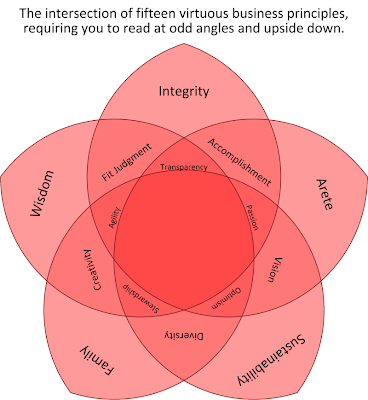
So it will then come as no surprise that the way I order my aspirational list of corporate values is as a set of rotating circular pentagonal intersecting sets. Okay, okay: it’s still a surprise.* Just think of it like a Spirograph. If you rotate a sequence of circles around another circle and you get a Spirograph. I rotated five circles around a central circle and dropped the outermost edge. Then I assigned a shortlist of related principles to each section. The outermost principles intersect to generate the interior principles (e.g. Integrity ∩ Arete = Accomplishment). I had a tiered values list sketched out in my head but I thought, I bet I can represent this idea in a way that indirectly calls on the lotus characterization of the noble eightfold path. I was probably also inspired by Indexed.
Here goes. You can click on the image below to pop up a larger version.
First tier principles:
˚˚ For all the harping I do on honesty, I didn't include it in the fifteen principles. Transparency under the auspice of Integrity necessarily assumes and includes honesty as a core value. There's actually quite a lot of that going on in the diagram. I wrote out more than five dozen candidates for inclusion. Many were eliminated after being subsumed by the relational implications of the fifteen finalist principles.
¹ There seems to be no consensus on whether it is pentalateral or pentilateral. Google shows more hits for the former, so that's what I went with. In the off chance anyone cares.
² I mean "family" in the sense of a close-knit unit that shares a common goal and endeavors to protect one another. I do mean to also imply the weathering of various minor snits.
³ This is the only one that I think is patently unintuitive. Thoughts?
⁴I do not like the phrase “fit judgment” but have yet to settle on a suitable synonym.
Did you know that I’m a math nerd? I’m no wonk, but I went pretty far in my studies before flipping out (number theory). I never really appreciated my mathematics intuition as a kid, but as a grownup, the knack has helped me shortcut a great many problems (money management, mapmaking, making interdisciplinary leaps: carrying capacity equilibrium can be expressed as a formula!).
So it will then come as no surprise that the way I order my aspirational list of corporate values is as a set of rotating circular pentagonal intersecting sets. Okay, okay: it’s still a surprise.* Just think of it like a Spirograph. If you rotate a sequence of circles around another circle and you get a Spirograph. I rotated five circles around a central circle and dropped the outermost edge. Then I assigned a shortlist of related principles to each section. The outermost principles intersect to generate the interior principles (e.g. Integrity ∩ Arete = Accomplishment). I had a tiered values list sketched out in my head but I thought, I bet I can represent this idea in a way that indirectly calls on the lotus characterization of the noble eightfold path. I was probably also inspired by Indexed.
Here goes. You can click on the image below to pop up a larger version.
First tier principles:
- Integrity
- Arete
- Sustainability
- Family²
- Wisdom
- Accomplishment = Integrity ∩ Arete
- Vision = Arete ∩ Sustainability
- Diversity = Sustainability ∩ Family
- Creativity³ = Family ∩ Wisdom
- Fit Judgment⁴ = Wisdom ∩ Integrity
Third tier principles:
- Passion = Integrity ∩ Arete ∩ Sustainability
- Optimism = Arete ∩ Sustainability ∩ Family
- Stewardship = Sustainability ∩ Family ∩ Wisdom
- Agility = Family ∩ Wisdom ∩ Integrity
- Transparency˚˚ = Wisdom ∩ Integrity ∩ Arete
˚˚ For all the harping I do on honesty, I didn't include it in the fifteen principles. Transparency under the auspice of Integrity necessarily assumes and includes honesty as a core value. There's actually quite a lot of that going on in the diagram. I wrote out more than five dozen candidates for inclusion. Many were eliminated after being subsumed by the relational implications of the fifteen finalist principles.
¹ There seems to be no consensus on whether it is pentalateral or pentilateral. Google shows more hits for the former, so that's what I went with. In the off chance anyone cares.
² I mean "family" in the sense of a close-knit unit that shares a common goal and endeavors to protect one another. I do mean to also imply the weathering of various minor snits.
³ This is the only one that I think is patently unintuitive. Thoughts?
⁴I do not like the phrase “fit judgment” but have yet to settle on a suitable synonym.
27 August 2007
Dude, this isn't a blog
It's a forum. My bad, as the cool kids say. And I really should have known better from the get-go. I was going to omit the next several paragraphs, but I’ve had several discussions with folks who wanted clarification around blogs versus forums.
A blog is an ordered series of articles, typically sorted chronologically. Interaction is limited to comments, which are aptly named since the blogger posts and readers then respond. The blog format is not especially conducive to much interaction. A blog is also really easy to set up and maintain.
A forum is a threaded written discussion, open to a wide audience and moderated by a central authority. Forums are sometimes, though not often, facilitated as well. They typically don’t need facilitation as there is presumably a large user base generating new discussion topics.
In general…
I am treating this blog essentially like a facilitated (if rigid) forum. Any time someone comments, I get a notification. And I am active in the comments of these posts [for which I also get a notification, since computers are a very dumb sort of magical animal]. I suppose that once the comments section gets too bulky or my site metrics show something like a critical mass of users, I’ll activate the blog’s Wonder Twin powers and make it take the shape of a forum. And presumably the form of a floodgate.
A blog is an ordered series of articles, typically sorted chronologically. Interaction is limited to comments, which are aptly named since the blogger posts and readers then respond. The blog format is not especially conducive to much interaction. A blog is also really easy to set up and maintain.
A forum is a threaded written discussion, open to a wide audience and moderated by a central authority. Forums are sometimes, though not often, facilitated as well. They typically don’t need facilitation as there is presumably a large user base generating new discussion topics.
In general…
- Blogs are centralized, quickly developing a strong sense of character. Unfacilitated forums are decentralized and often lack that character or have a diffuse tone from all the divergent voices.
- Forums are keenly collaborative while blogs are inclined to be narrative.
- When it comes to the ideas expressed in the content, blogs promote dissemination and forums promote discussion.
I am treating this blog essentially like a facilitated (if rigid) forum. Any time someone comments, I get a notification. And I am active in the comments of these posts [for which I also get a notification, since computers are a very dumb sort of magical animal]. I suppose that once the comments section gets too bulky or my site metrics show something like a critical mass of users, I’ll activate the blog’s Wonder Twin powers and make it take the shape of a forum. And presumably the form of a floodgate.
26 August 2007
I'm tired, I'm curious, this is short
Does a company need to be good for you to want to be a part of it? Does this strike you as a vanity project or a pipe dream?
I'm not fishing for reassurance, so don't feel like you need to console me on this point.
I'm not fishing for reassurance, so don't feel like you need to console me on this point.
23 August 2007
Good faith
If you are not being negotiated with in good faith, do you yourself need to continue to act in good faith to remain righteous, even if that means you will be exploited?
Here’s one example that I’ve run up against a number of times. I know plenty of other folks who have as well, so I’m not being especially facetious or arrogant in positing this as a case study.
You can do your job, week in and week out, in just one day (yes: for whatever reason, you are many times over as effective at the job as the job ["job"] warrants). All your commitments are met, no one has cause to complain about your performance, it actually would reasonably take someone else a full week to do what you can do in a day. There is either no indication, or it is explicitly clear, that you will not be compensated in kind for your performance.
Here is how I have reacted:
Here’s one example that I’ve run up against a number of times. I know plenty of other folks who have as well, so I’m not being especially facetious or arrogant in positing this as a case study.
You can do your job, week in and week out, in just one day (yes: for whatever reason, you are many times over as effective at the job as the job ["job"] warrants). All your commitments are met, no one has cause to complain about your performance, it actually would reasonably take someone else a full week to do what you can do in a day. There is either no indication, or it is explicitly clear, that you will not be compensated in kind for your performance.
Here is how I have reacted:
- Specifically not do more for the benefit of the team [I should describe in full why I think this option is important to consider - perhaps I'll update this post when I've more time].
- Do more anyway to fulfill some personal need.
- Do more anyway because I thought I could somehow use my demonstrated superior performance to leverage some kind of alternate compensation.
- Negotiate a strange deal with my boss and do an additional day or two more.
- Do my one work day and invest the remaining four days elsewhere.
- Quit.
The first and last are the only ones that have satisfied me for more than a very short duration.
22 August 2007
Bad habit: gossip to more than one person
Now, I'm not saying that gossiping to one person is a great idea. Gossip at your own peril, Cap'n Chatty. But if gossiping is in your nature then plan well, be discreet, make no records (yes, please do assume that IM recorded everything you typed and served it up to your boss and the whole of the internet), and please only gossip to one trusted confidante (preferably not a coworker). If you gossip to blow off steam – find another outlet because you are greatly increasing the chance that you are headed for a fall. At least don’t lie or exaggerate. When you get caught gossiping, at least be able to back up your slander with fact or some kind of evidence.
When you gossip to multiple people, you greatly increase the chance of spreading the gossip. You are implying that it is not a secret, and each of your vectors can point to one another to say they’re not the one. Secrets are a burden on others anyhow, so that cat’s probably coming out of the bag.
If you are gossiping to more than one trusted confidante I’ll go out on a limb and say that there’s a good chance that you don’t have even one confidante. But you do have poor judgment in where to place your trust.
If you told two people something, one of them is going to tell me. They will tell me because gossiping is a social lubricant and a guilty pleasure. They will tell me because today you made them mad. They will tell me because you badmouthed me and I’m a standup guy. They will tell me because you haven’t told them anything juicy lately and they are bored and I brought in cookies today and they are really good and did I know that… They will tell me because I said something interesting and they want to say something interesting too. They will tell me because what if I flip out: trainwrecks are fun to rubberneck at. They will tell me because they can’t stand gossipers, but…
Seriously, they are going to tell me. They do tell me. I wouldn't be writing this if there hadn't been a decade-long flow of people into and out of my office to drop off dirty laundry.
You’ll be lucky if I’m the first or only person they tell. Because I like to gossip and I know full well that it’s a terrible idea. So if I’m feeling strong and virtuous, I’ll tell them to kindly not go any further. And then I’ll tell you.
When you gossip to multiple people, you greatly increase the chance of spreading the gossip. You are implying that it is not a secret, and each of your vectors can point to one another to say they’re not the one. Secrets are a burden on others anyhow, so that cat’s probably coming out of the bag.
If you are gossiping to more than one trusted confidante I’ll go out on a limb and say that there’s a good chance that you don’t have even one confidante. But you do have poor judgment in where to place your trust.
If you told two people something, one of them is going to tell me. They will tell me because gossiping is a social lubricant and a guilty pleasure. They will tell me because today you made them mad. They will tell me because you badmouthed me and I’m a standup guy. They will tell me because you haven’t told them anything juicy lately and they are bored and I brought in cookies today and they are really good and did I know that… They will tell me because I said something interesting and they want to say something interesting too. They will tell me because what if I flip out: trainwrecks are fun to rubberneck at. They will tell me because they can’t stand gossipers, but…
Seriously, they are going to tell me. They do tell me. I wouldn't be writing this if there hadn't been a decade-long flow of people into and out of my office to drop off dirty laundry.
You’ll be lucky if I’m the first or only person they tell. Because I like to gossip and I know full well that it’s a terrible idea. So if I’m feeling strong and virtuous, I’ll tell them to kindly not go any further. And then I’ll tell you.
Subscribe to:
Posts (Atom)